
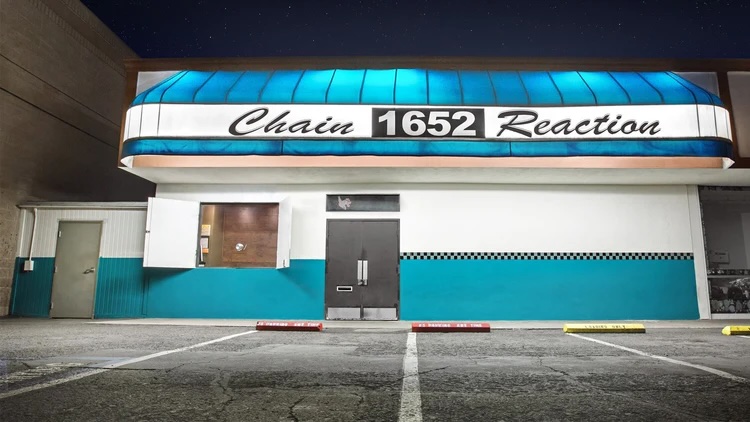
Orange County has always had a complicated relationship with letting go. Places you thought would outlive you suddenly vanish, leaving only stories that sound less believable as the years pass. The Doll Hut, where bands played to ten people and somehow still gave the room meaning. Avalon Bar, a place that felt like both a living room and a dare. Even the Omelette Parlor’s and dives that helped us shake off the previous night’s transgressions, those lights faded until we were left pointing at empty storefronts saying, “That used to be something.”
And now Chain Reaction joins them.
It’s strange to talk about the end of a venue that never really pretended to be anything more than four walls, a stage, and enough duct-taped solutions to keep the speakers from rattling apart. But for more than twenty-five years, that little room in Anaheim did something no corporate venue ever could: it gave every awkward, hopeful kid a place to exist.

If you grew up here, chances are you sweated through a hoodie inside that building. Or you waited in a line that wrapped around the block on a night when the air smelled like cigarettes and asphalt, anxiously waiting as the faint tuning of guitars rattled the walls nearby. Maybe you pushed your way to the front, or maybe you hugged the back, hoping the music would shake something loose inside you. Either way, the room left a mark.
Chain Reaction wasn’t polished. It wasn’t pretty. It wasn’t even particularly comfortable. But it was ours. A place where bands learned who they were long before Spotify playlists tried to tell them. A place where the scene didn’t just grow, it collided, combusted, and kept reinventing itself every time a kid with a cheap guitar decided they had something to say.
Over the last few days I spent countless hours on Youtube, reliving as many shows as I can remember. From the no holds barred chaos of Graf Orloc’s final show, to the absolutely sweatiest, wettest, and downright dangerous crowd I can remember–Bury Your Dead, the closing of Chain will be felt much further than the county line. We watched bands like Paramore and My Chemical Romance blossom into global talents on the same stage everyone else had equal access to. And in today’s musical landscape, that’s almost unheard of.
No venue will replace Chain Reaction as it was never floating in a vacuum. It came from the same lineage of all-ages spaces that kept getting shut down, bought out, remodeled, or paved over. It sprang up because something else had vanished.
When an institution like Chain Reaction closes, it doesn’t create emptiness. It creates pressure. That pressure becomes momentum. And that momentum always, always finds a new room.

While the reality of OC losing its beloved venue is still a fresh wound for most, the county still has spaces that are willing to exist outside of the “Big-box Festival” type of shows that seem to be the growing industry standard. Just down the freeway, tucked behind Garden Grove’s civic center and hiding in plain sight behind rows of greenery, sits The Garden Amp. Bigger. Breezier. A little weirder, but in the best way.
Like many, my first experience at The Garden Amp had me questioning my GPS as I made a quick left turn off the 22 freeway. After parking (free), I made my way through security to take my spot in the crowd while we all eagerly waited for the house lights to go down. It was Turnstile’s first performance at the venue but by the end of their set everyone there knew it was probably their last. As they were surely headed for far bigger stages around the world.
Since that show I have seen the same bands that once graced the stage at Chain Reaction, direct the same kind of connections inside the stadium-style seating of Garden Amp’s outdoor theater. Saosin, whose 2014 and 2018 reunion shows were hosted at Chain, now routinely sells out The Garden Amp several nights a year.
The Garden Amp didn’t ask to become the heir to anything. At least it doesn’t feel like it. Instead, they just keep booking shows—punk, ska, metal, indie, whatever—and have built a home out of consistency. While other venues are still trying to figure out how to survive shifting trends, Garden Amp has quietly become the venue you discovered at a show you almost didn’t go to. The one that made you feel like maybe the scene wasn’t dying after all—it was just learning to grow somewhere else.
I think Patrick Kindlon, lead singer of Drug Church said it best when he performed recently with Comeback Kid and Four Year Strong:
